

As a dedicated supplier of HVOF coated screws, I've witnessed firsthand the transformative impact these precision-engineered components can have across a multitude of industries. High-Velocity Oxygen Fuel (HVOF) coating technology has revolutionized the performance and durability of screws, making them indispensable in applications where reliability and longevity are non - negotiable. In this blog, I'll delve into the intricacies of optimizing the design of HVOF coated screws for specific applications, sharing insights gleaned from years of experience in the field.
Understanding HVOF Coating Technology
Before we dive into the optimization process, it's crucial to understand what HVOF coating entails. HVOF is a thermal spray process that involves the combustion of a fuel gas and oxygen in a combustion chamber. The resulting high - velocity jet is used to heat and accelerate powdered coating material towards a substrate, in this case, the screw. The coating material, often tungsten carbide or other hard ceramics, bonds to the screw surface, forming a dense, wear - resistant layer.
The benefits of HVOF coating are manifold. It significantly enhances the screw's hardness, corrosion resistance, and wear resistance. This means that screws can withstand harsh operating conditions, such as high temperatures, abrasive materials, and corrosive chemicals, without succumbing to premature failure.
Assessing the Specific Application
The first step in optimizing the design of HVOF coated screws is to thoroughly assess the specific application. Different industries and applications have unique requirements that must be taken into account.
Industry - Specific Requirements
- Aerospace: In the aerospace industry, weight is a critical factor. Screws need to be lightweight while still maintaining high strength and corrosion resistance. HVOF coated screws can be designed with thinner but highly effective coatings to meet these demands. For example, a titanium alloy screw with a thin HVOF tungsten carbide coating can provide the necessary strength and wear resistance without adding excessive weight.
- Automotive: Automotive applications often involve high - speed and high - torque operations. Screws need to have excellent fatigue resistance and the ability to maintain their clamping force over time. The HVOF coating can be optimized to improve the surface finish of the screw, reducing friction and wear during repeated use.
- Oil and Gas: In the oil and gas industry, screws are exposed to highly corrosive environments and abrasive drilling fluids. HVOF coated screws with corrosion - resistant coatings, such as chromium carbide, can protect the screw from rust and degradation, ensuring reliable performance in offshore platforms and drilling rigs.
Operating Conditions
- Temperature: High - temperature applications require coatings that can withstand thermal stress. For instance, in power generation plants, where screws are used in boilers and turbines, HVOF coatings with high melting points and good thermal stability are essential. Some advanced coatings can maintain their integrity at temperatures exceeding 1000°C.
- Pressure: In applications involving high pressure, such as hydraulic systems, the coating must be able to adhere firmly to the screw surface without delaminating. The coating thickness and composition can be adjusted to withstand the pressure forces.
Material Selection for the Screw and Coating
The choice of materials for both the screw substrate and the HVOF coating is crucial for optimization.
Screw Substrate
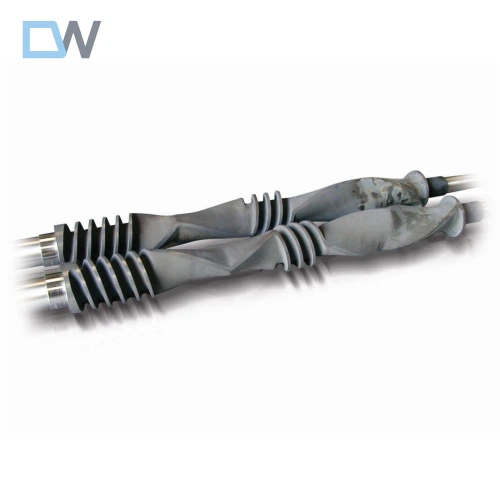
- Steel: Through - hardened steel is a popular choice for screw substrates due to its high strength and toughness. HVOF Tungsten Carbide Coated Screw with Through Hardened Steel offers a good balance of mechanical properties. The through - hardening process ensures that the entire screw has consistent hardness, providing a stable base for the HVOF coating.
- Alloys: Depending on the application, other alloys such as stainless steel, titanium, or nickel - based alloys may be used. Stainless steel offers excellent corrosion resistance, while titanium is lightweight and has high strength - to - weight ratio.
Coating Material
- Tungsten Carbide: Tungsten carbide is one of the most commonly used HVOF coating materials. It has high hardness, excellent wear resistance, and good thermal stability. Tungsten carbide coatings can be customized by adjusting the particle size and the binder material (usually cobalt or nickel) to achieve different levels of hardness and toughness.
- Chromium Carbide: Chromium carbide coatings are known for their superior corrosion resistance. They are often used in applications where the screw is exposed to corrosive chemicals or environments.
Design Considerations
Once the application requirements and materials are determined, several design considerations come into play.
Coating Thickness
The thickness of the HVOF coating is a critical parameter. A thicker coating generally provides better wear and corrosion resistance, but it may also increase the risk of coating delamination and affect the dimensional accuracy of the screw. For most applications, a coating thickness in the range of 50 - 250 microns is typical. However, in highly abrasive environments, thicker coatings up to 500 microns may be required.
Surface Finish
The surface finish of the screw before and after coating is important. A smooth surface finish on the substrate can improve the adhesion of the HVOF coating. After coating, a fine - tuned surface finish can reduce friction and improve the screw's performance. For example, in precision machinery, a mirror - like surface finish on the coated screw can minimize wear and ensure smooth operation.
Thread Design
The thread design of the screw can also be optimized. The pitch, depth, and shape of the threads can affect the clamping force, torque transmission, and self - locking properties of the screw. For applications where high clamping force is required, a coarse - pitched thread with a large flank angle may be more suitable.
Testing and Validation
After the initial design of the HVOF coated screw is completed, rigorous testing and validation are necessary to ensure that the screw meets the specific application requirements.
Laboratory Testing
- Hardness Testing: The hardness of the coating and the substrate can be measured using techniques such as Rockwell or Vickers hardness testing. This helps to verify that the coating has the desired hardness for wear resistance.
- Adhesion Testing: Adhesion testing, such as scratch testing or pull - off testing, is used to evaluate the bond strength between the coating and the substrate. A strong bond is essential to prevent coating delamination during use.
- Wear Testing: Wear testing can be conducted using pin - on - disk or abrasion testing machines. This simulates the real - world wear conditions and helps to determine the wear rate of the coated screw.
Field Testing
Field testing involves installing the HVOF coated screws in the actual application environment. This provides valuable feedback on the screw's performance under real - world conditions. Data such as the number of cycles, operating temperature, and failure rate can be collected and analyzed to further optimize the design.
Conclusion
Optimizing the design of HVOF coated screws for specific applications is a complex but rewarding process. By understanding the application requirements, carefully selecting materials, considering design factors, and conducting thorough testing, we can create screws that offer superior performance, durability, and reliability.
If you're in need of high - quality HVOF coated screws for your specific application, I invite you to reach out for a detailed discussion. Our team of experts is ready to work with you to develop customized solutions that meet your exact needs. Whether you're in the aerospace, automotive, oil and gas, or any other industry, we have the knowledge and experience to deliver the best - in - class HVOF coated screws.
References
- Smith, J. (2018). "Advances in HVOF Coating Technology for Industrial Applications". Journal of Surface Engineering and Tribology.
- Jones, A. (2019). "Material Selection for HVOF Coated Components". Materials Science Review.
- Brown, C. (2020). "Design Considerations for HVOF Coated Fasteners". Engineering Design Journal.


