


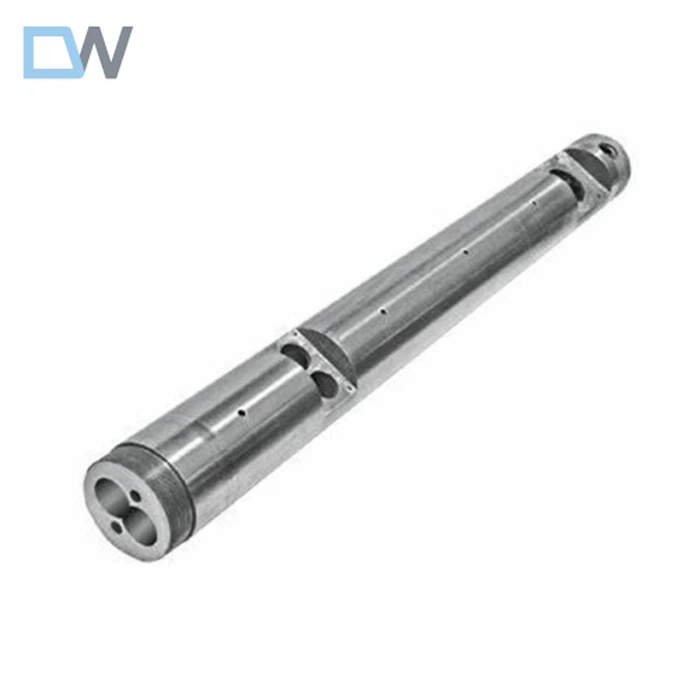
The barrel and screw constitute the extrusion system. Like the screw, the barrel also works under high pressure, high temperature, severe wear, and certain corrosion conditions. In the extrusion process, the barrel also has the function of transferring heat to or away from the material. A heating and cooling system is also provided on the barrel, and the machine head is installed.
In addition, a feeding port should be opened on the barrel. The geometry of the feeding port and its location have a great influence on the feeding performance. The smoothness of the inner surface of the barrel and the grooves on the inner wall of the feeding section have a great influence on the extrusion process.
Benefits of Injection Barrel
Melting and homogenization of plastic materials
The primary function of the injection molding barrel is to melt and homogenize the plastic materials. As the plasticizing screw rotates within the barrel, it generates heat through friction, melting the solid plastic pellets or granules.
The barrel’s internal heating elements provide additional heat as needed, ensuring complete melting and homogenization of the plastic material and eliminating any inconsistencies or unmelted particles.
Mixing and dispersion of additives
In addition to melting the base plastic material, the injection molding barrel facilitates the mixing and dispersion of various additives. Additives such as colorants, reinforcing agents, flame retardants, and lubricants are often incorporated into the plastic material to enhance specific properties.
The barrel’s design and internal geometry, along with the rotation of the screw, promote thorough mixing and dispersion of these additives, ensuring uniform distribution within the melted plastic.
Temperature control and stability
The plastic injection molding barrel features precise temperature control mechanisms. Heating elements embedded in the barrel maintain the desired temperature profile for effectively melting and processing the plastic material.
Proper temperature control is crucial for preventing overheating or underheating, as it directly affects the viscosity, flow, and quality of the molten plastic. Stable and consistent temperature control within the plastic injection molding barrel ensures reliable processing and optimized part quality.
Abrasion and corrosion resistance
The plasticizing screw inside the barrel is subjected to significant wear due to the abrasive nature of plastic materials. In order to counteract this, manufacturers use durable, wear-resistant materials to construct the barrel, enabling it to withstand repeated friction and contact with the plasticizing screw.
Hardened steel or bimetallic alloys enhance the barrel’s resistance to abrasion, extending its lifespan and reducing the need for frequent replacements or maintenance.
Types of Injection Barrel
1.Integral barrel
It is processed on the whole blank. This structure is easy to ensure high manufacturing accuracy and assembly accuracy, and also can simplify the assembly work, which is convenient for the installation and disassembly of heating and cooling system. Moreover, the heat is evenly distributed along the axial direction. Naturally, this kind of barrel requires higher processing and manufacturing conditions.
2.Combined barrel
It means that a barrel is composed of several barrel sections. The experimental extruder and the exhaust extruder use the combined barrel. The former is for the convenience of changing the length of the barrel to adapt to the screw with no aspect ratio, and the latter is for setting the exhaust section.
In a certain sense, the use of composite barrel is conducive to local materials and processing, and is beneficial to small and medium-sized factories. But in fact, the machining accuracy of combined barrel is very high. Each section of the combined barrel is connected with flange bolts. In this way, the uniformity of barrel heating is destroyed and the heat loss is increased. It is not convenient for the setting and maintenance of heating and cooling system.
3.Bimetal barrel
In order to not only meet the material requirements of the barrel for injection molding, but also save valuable materials, many barrels are inlaid with an alloy steel bushing in the matrix of general carbon steel or cast steel. After the Bush is worn out, it can be removed and replaced. The Bush should be well matched with the barrel to ensure that the heat conduction on the whole barrel wall is not affected; There is no relative movement between the barrel and the bushing, and it can be easily removed, so it is necessary to select the appropriate matching precision, which is adopted by some factories.
4.IKV barrel
1)Longitudinal groove is set on the inner wall of feeding section of barrel
In order to improve the solid conveying rate, according to the solid conveying theory, one method is to increase the friction coefficient of the material cylinder surface, and another method is to increase the area of the material passing through the cross section perpendicular to the screw axis at the feeding port. The two methods are to set up longitudinal groove on the inner wall of the feeding section and to make the inner wall of the feeding section near the feeding mouth into a cone.
2)Forced cooling feeding section barrel
In order to improve the solid conveying capacity, there is another method. The purpose is to keep the temperature of the transported material below the softening point or melting point, avoid the appearance of molten film, and maintain the solid friction property of the material.
Material of Injection Barrel
Just like the screw, in order to meet the working requirements of the barrel, it must be made of high-quality high-temperature, wear-resistant, corrosion-resistant and high-strength materials. These materials should also have good machinability and heat treatment properties. In addition to 45# steel, 40Cr, 38CrMoAL, the barrel can also be made of cast steel and ductile iron. The lined feed section can be made of high-quality cast iron.
In recent years. With the development of high-speed extrusion and engineering plastics, especially when extruding glass fiber reinforced plastics and plastics containing inorganic fillers, higher requirements are placed on the wear resistance and corrosion resistance of the barrel. Xaloy alloy developed by the United States, Belgium and other countries is a novel wear-resistant and corrosion-resistant material, which is currently widely used abroad. This material has a low melting point, is hard, has good weldability with steel, has good machinability, good casting performance, and has no casting stress. Even if it is bent after casting, it will not fall off in scales.
It is applied to the barrel in this way: the powdered Xaloy alloy and the barrel are heated together at a high temperature. Due to its low melting point, it can be melted into a flowing state at about 1200 ° C. The barrel rotates at high speed, and the huge centrifugal force generated by the molten Xaloy makes it cast on the inner wall of the red-hot barrel with a thickness of about 2 mm. General barrel requirements.
How to Set the Injection Barrel Temperature of the Injection Mold
Measuring barrel temperature
The importance of injection molding from China in the process of manufacturing relies greatly on the accurate measurement of the barrel temperature. The process of measuring the barrel temperature will be useful for the overall result of the production. However, in order to achieve the optimal barrel temperature, you have to be reminded that the temperature zones on the barrel should be consistent throughout. Temperatures are usually measured in Celsius or Fahrenheit.
Avoid zone-temperature override which happens when one of the temperature zones on the barrel of the plastic injection molding machine because this will result in unexpected defects in the product. One way to control the zone temperature is to cycle between the on and off button of the temperature controller. This way, you are able to know if you are close to achieving the optimal temperature for the process.
Thermocouple placement
If you ask your partner plastic molding company about the most crucial part of setting barrel temperatures in plastic mold manufacturing, they are bound to tell you about thermocouple placement and contact area. A thermocouple is a thermoelectric device that is used for measuring temperature. It consists of two wires made from different metals connected at two points. In thermocouples, the voltage running between the two junctions is proportional to the temperature difference in producing plastic parts.
It is essential that thermocouple placement is discussed upon production because it makes all the difference in improving barrel-temperature measurement and control. It may seem simple to measure barrel temperature, but considerations and strict compliance with the design requirements are needed in order to make a satisfactory result.
Temperature sensing
This step is also crucial in setting barrel temperatures for plastic products. Injection mold suppliers in China ensure that the parts of the production process are well-maintained and efficient to work on a project. Temperature sensing makes use of this capability as this process is done by further utilizing thermocouples on plastic injection molding machines. Temperatures are sensed by seeing if the thermocouple is calibrated at a stable temperature, also known as the reference temperature. This allows the simple and accurate measurements of the temperatures.
Small electrical signals are generated when one end of the barrel is hotter than the other. A thermocouple consists of two different wires joined at each end. More heat generated means that the electrical signal is greater. Temperatures are sensed using thermocouples on most injection molding machines.
Temperature setting
Employing temperature setting in plastic injection molding suggests that one begins with the lowest settings for the processing of a specific grade of material. Injection barrels should be divided into zones for easy temperature setting, recording, and control. Keep in mind that to achieve optimum temperature setting, you can also set them to the same value. The first zone temperature should start with a lower value if you are working alongside higher temperatures or if the cycle times are long. Doing this will prevent premature molding defects like bridging and melting. Before starting the injection molding process, you should ask your supplier if the barrel, mold, hopper block, and the hydraulic oil are all set to the correct temperatures.
Temperature recording
Injection molding processes need to be properly set according to the desired temperature. It should then recorded by indicated machine setting record. The temperature recording will include melt temperatures, mold temperatures, water temperatures, and oil temperatures. The increasing number of temperature measuring point should also be indicated.
There should also be an integration of an instrument that touches upon the variety of probes together with an electronic, portable temperature sensor or thermometer which can be useful in the injection molding process. Recording the temperature will also be useful in case you want to use it for future projects and for research purposes.
Our Factory
DW Machinery owns series of advanced equipment, such as CNC Machining Center, CNC Turning Machine, Inner Hole Grinding Machine, 13 Meters Deep Hole Boring Machine, NC drilling machine, Nitriding Furnace Computer Control System, Centrifugal Casting Furnace, PTA Bimetallic Spraying Equipment, gear milling machine and so on.
We believe that high quality products, as well as excellent sales and after-sales service, are the key to building long-term customer relationship. Our customer service team strives to help you to solve any problems that you may encounter.

FAQ