

When it comes to manufacturing high - performance screws, HVOF (High - Velocity Oxygen Fuel) coating has emerged as a game - changer. As a leading HVOF coated screw supplier, I understand the importance of selecting the appropriate HVOF coating parameters for screws. This blog will delve into the key factors and steps involved in making this crucial decision.
Understanding HVOF Coating
HVOF coating is a thermal spray process that uses a high - velocity jet of hot gases to accelerate powder particles onto a substrate. This results in a dense, well - bonded coating that can significantly enhance the surface properties of screws, such as wear resistance, corrosion resistance, and hardness.
The basic principle of HVOF coating involves mixing a fuel gas (such as propane, propylene, or hydrogen) with oxygen in a combustion chamber. The mixture is ignited, creating a high - velocity flame. Powdered coating material is then injected into the flame, where it is heated and accelerated towards the substrate.
Importance of Appropriate Coating Parameters
Selecting the right HVOF coating parameters is essential for several reasons. Firstly, it directly affects the quality of the coating. A well - optimized set of parameters can ensure a uniform, defect - free coating with excellent adhesion to the screw substrate. This, in turn, enhances the performance and durability of the screw.
Secondly, appropriate coating parameters can improve production efficiency. By minimizing coating defects and reducing the need for post - coating processing, the overall manufacturing time and cost can be significantly reduced.
Factors to Consider When Selecting Coating Parameters
Coating Material
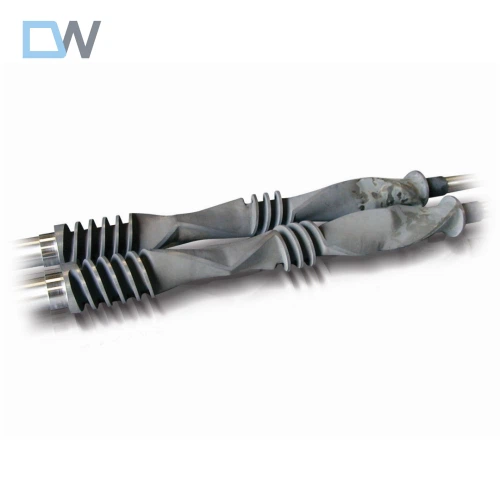
The choice of coating material is one of the most critical factors. Different materials offer different properties. For example, tungsten carbide is known for its high hardness and wear resistance, making it an ideal choice for screws that are subjected to high - stress applications. HVOF Tungsten Carbide Coated Screw with Through Hardened Steel is a popular option in the market due to its excellent performance.
When selecting the coating material, consider the operating conditions of the screw, such as the type of contact it will have (abrasive, adhesive, etc.), the temperature range, and the presence of corrosive substances.
Substrate Material
The substrate material of the screw also plays a vital role in determining the coating parameters. Different substrate materials have different thermal expansion coefficients, surface roughness, and chemical compositions. For instance, if the substrate is a soft metal, a lower spraying temperature may be required to avoid substrate deformation. On the other hand, a hard substrate may require a higher particle velocity to ensure good coating adhesion.
Coating Thickness
The desired coating thickness is another important factor. Thicker coatings generally provide better wear and corrosion protection but may also increase the risk of cracking and delamination. The coating thickness should be carefully selected based on the application requirements. For light - duty applications, a thinner coating may be sufficient, while heavy - duty applications may require a thicker coating.
Spraying Distance
The spraying distance between the gun and the screw surface affects the particle velocity and temperature at the point of impact. A shorter spraying distance typically results in higher particle velocity and temperature, which can improve coating adhesion. However, if the distance is too short, the substrate may be over - heated, leading to thermal damage. Conversely, a longer spraying distance may result in lower particle velocity and reduced coating quality.
Fuel - Oxygen Ratio
The fuel - oxygen ratio in the combustion chamber affects the flame temperature and velocity. A higher fuel - oxygen ratio generally leads to a hotter and faster flame, which can increase the particle velocity and melting degree. However, an excessive fuel - oxygen ratio may also cause incomplete combustion and generate soot, which can contaminate the coating.
Powder Feed Rate
The powder feed rate determines the amount of coating material being sprayed onto the screw surface per unit time. A higher powder feed rate can increase the coating thickness, but it may also lead to poor particle melting and coating quality. A lower powder feed rate, on the other hand, may result in a thinner coating and longer processing time.
Steps for Selecting Appropriate Coating Parameters
Conduct a Needs Assessment
Before selecting the coating parameters, it is essential to understand the specific requirements of the screw application. This includes factors such as the expected service life, the operating environment, and the performance criteria.
Review Existing Literature and Case Studies
There is a wealth of information available in the scientific literature and industry case studies regarding HVOF coating parameters for different applications. Reviewing this information can provide valuable insights and help in making an informed decision.
Perform Preliminary Tests
Conduct preliminary tests using different sets of coating parameters on sample screws. Evaluate the coating quality, adhesion, and performance of these samples. This can help in narrowing down the range of suitable parameters.
Optimize the Parameters
Based on the results of the preliminary tests, further optimize the coating parameters. This may involve adjusting one or more factors, such as the spraying distance, powder feed rate, or fuel - oxygen ratio, to achieve the best possible coating quality.
Validate the Parameters
Once the parameters are optimized, validate them through full - scale production tests. Monitor the coating quality and performance during production to ensure that the selected parameters are reliable and reproducible.
Quality Control and Assurance
Throughout the process of selecting and applying the HVOF coating parameters, quality control and assurance are of utmost importance. Regularly inspect the coated screws using non - destructive testing methods, such as ultrasonic testing and X - ray diffraction, to detect any internal defects. Conduct adhesion tests and hardness tests to ensure that the coating meets the specified requirements.
Conclusion
Selecting the appropriate HVOF coating parameters for screws is a complex but crucial process. By considering factors such as the coating material, substrate material, coating thickness, spraying distance, fuel - oxygen ratio, and powder feed rate, and following a systematic approach that includes needs assessment, preliminary testing, optimization, and validation, high - quality coated screws can be produced.
As a professional HVOF coated screw supplier, we are committed to providing our customers with the best - in - class products. If you are interested in our HVOF coated screws or have any questions about the coating process and parameter selection, please feel free to contact us for procurement discussions. We look forward to working with you to meet your specific needs.
References
- Smith, J. (2018). Thermal Spray Coatings: Principles and Applications. Elsevier.
- Jones, A. (2019). Advances in High - Velocity Oxygen Fuel Coating Technology. Journal of Thermal Spray Technology, 28(6), 1023 - 1035.
- Brown, C. (2020). Coating Parameter Optimization for HVOF - Sprayed Components. Proceedings of the International Conference on Surface Engineering, 2020, 45 - 52.


