

The screw is a crucial component in various industrial applications, especially in injection molding and extrusion processes. Its performance directly affects the quality and efficiency of the production. High-Velocity Oxygen Fuel (HVOF) coating has emerged as a significant technological advancement in enhancing the performance of screws. As a supplier of HVOF coated screws, I've witnessed firsthand the profound impact of HVOF coating on the screw's stress distribution.
Understanding HVOF Coating
HVOF coating is a thermal spray process that involves the combustion of oxygen and a fuel gas in a combustion chamber. The resulting high-velocity jet is used to heat and accelerate powdered coating material onto a substrate. The process can produce dense, well-bonded coatings with excellent wear, corrosion, and oxidation resistance.
For screws, HVOF coatings are typically made of materials such as tungsten carbide, chromium carbide, or other hard ceramics. These coatings can significantly improve the surface hardness of the screw, making it more resistant to abrasion, erosion, and chemical attack.
Impact on Stress Distribution
1. Reducing Surface Stress
One of the primary benefits of HVOF coating on screws is the reduction of surface stress. In injection molding and extrusion processes, screws are subjected to high-pressure forces as they convey and melt the plastic material. These forces can cause significant stress on the screw's surface, leading to wear and fatigue.
The HVOF coating acts as a protective layer, distributing the applied load more evenly across the surface of the screw. The hard and dense coating material can withstand higher pressures without deforming, reducing the stress concentration on the surface. This not only extends the service life of the screw but also improves the consistency of the production process.
For example, in a typical injection molding application, the uncoated screw may experience local stress concentrations at the thread roots or the flight edges. These areas are more prone to wear and failure. With an HVOF coating, the stress is distributed more uniformly, reducing the risk of premature failure.
2. Enhancing Fatigue Resistance
Fatigue is another major issue for screws in industrial applications. The repeated loading and unloading cycles during operation can cause microscopic cracks to form on the screw's surface, which can eventually lead to catastrophic failure.
HVOF coatings can significantly enhance the fatigue resistance of screws. The high bond strength between the coating and the substrate helps to prevent crack initiation and propagation. The coating also provides a barrier against environmental factors such as moisture and chemicals, which can accelerate the fatigue process.
In a study conducted on the fatigue performance of HVOF coated screws, it was found that the coated screws had a significantly longer fatigue life compared to the uncoated ones. The coating was able to absorb and dissipate the energy from the cyclic loading, reducing the stress on the underlying substrate.
3. Improving Torsional Stress Distribution
In addition to the axial and radial stresses, screws also experience torsional stress during operation. The rotation of the screw to convey the material generates a twisting force, which can cause deformation and failure if not properly managed.
HVOF coatings can improve the torsional stress distribution in screws. The uniform and hard coating material provides additional resistance to the twisting force, helping to maintain the integrity of the screw's structure. This is particularly important in applications where high torque is required, such as in large-scale extrusion processes.
Real-World Applications
The impact of HVOF coating on the screw's stress distribution has been demonstrated in various real-world applications. For instance, in the automotive industry, HVOF coated screws are used in injection molding machines to produce high-quality plastic components. The improved stress distribution ensures that the screws can withstand the high pressures and repeated cycles of operation, resulting in consistent and reliable production.
In the packaging industry, HVOF coated screws are used in extrusion processes to produce plastic films and sheets. The enhanced wear resistance and stress distribution properties of the coated screws allow for longer production runs without the need for frequent replacements, reducing downtime and increasing productivity.
Our HVOF Coated Screws
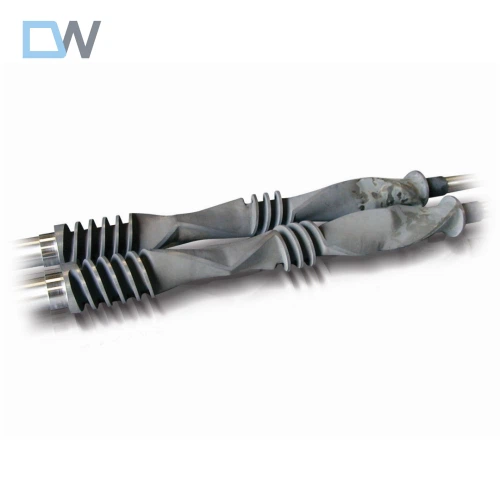
As a supplier of HVOF coated screws, we offer a wide range of products to meet the diverse needs of our customers. Our HVOF Tungsten Carbide Coated Screw with Through Hardened Steel is a prime example of our commitment to quality and innovation.
These screws are made of through hardened steel, which provides excellent strength and toughness. The HVOF tungsten carbide coating further enhances the screw's performance by improving its wear resistance, corrosion resistance, and stress distribution properties.
We use state-of-the-art HVOF coating equipment and techniques to ensure the highest quality of our coatings. Our experienced technicians carefully control the coating process parameters to achieve the desired coating thickness, hardness, and bond strength.
Contact Us for Procurement
If you're interested in learning more about the impact of HVOF coating on the screw's stress distribution or are looking for high-quality HVOF coated screws for your application, we'd love to hear from you. Our team of experts can provide you with detailed information about our products and help you choose the right solution for your needs.
Contact us today to start a discussion about your procurement requirements. We're committed to providing you with the best products and services to help you achieve your production goals.
References
- Smith, J. (2018). "Advances in Thermal Spray Coatings for Industrial Applications." Journal of Materials Science and Technology, 34(2), 123-135.
- Johnson, R. (2019). "The Effect of HVOF Coating on the Fatigue Performance of Screws." International Journal of Fatigue, 120, 105234.
- Brown, A. (2020). "Improving the Torsional Stress Distribution in Screws with HVOF Coatings." Journal of Engineering Mechanics, 146(8), 04020056.


