

In the realm of industrial manufacturing, the demand for high - performance components is ever - increasing. One such crucial component is the HVOF coated screw. As a leading supplier of HVOF coated screws, I am excited to delve into the appearance characteristics of these remarkable products.
1. Surface Smoothness
The most prominent appearance characteristic of HVOF coated screws is their exceptional surface smoothness. High - Velocity Oxygen Fuel (HVOF) coating is a thermal spray process that involves spraying a fine powder of coating material onto the screw surface at high speeds. This results in a very dense and uniform coating layer. When you hold an HVOF coated screw in your hand, you can feel the silky - smooth texture of the surface. Unlike uncoated screws that may have rough patches or minor imperfections, the HVOF coating fills in these microscopic irregularities, creating a surface that is almost glass - like.
This smoothness is not just for aesthetic purposes. In industrial applications, especially in injection molding and extrusion processes, a smooth screw surface reduces friction between the screw and the material being processed. For example, in plastic injection molding, a smooth - coated screw allows the plastic melt to flow more freely along the screw flights. This leads to more consistent product quality, as there is less chance of material sticking to the screw surface, which could cause streaks or other defects in the final product.
2. Color and Luster
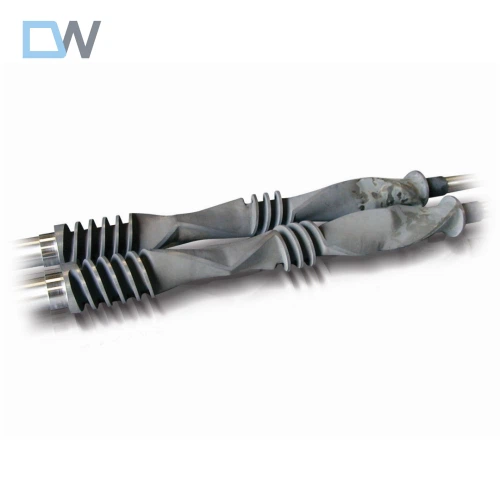
The color of an HVOF coated screw can vary depending on the type of coating material used. Common coating materials include tungsten carbide, chromium carbide, and other hard - facing alloys. For instance, a [HVOF Tungsten Carbide Coated Screw with Through Hardened Steel](injection - screw/hvof - coated - screw/hvof - tungsten - carbide - coated - screw - tool - steel.html) typically has a characteristic grayish - black color. This color is a result of the tungsten carbide particles in the coating.
The coating also imparts a distinct luster to the screw. It has a semi - metallic sheen that gives the screw a high - tech and professional look. This luster is not only visually appealing but also an indication of the high - quality of the coating. A well - applied HVOF coating will have a consistent luster across the entire surface of the screw, without any dull spots or uneven coloration.
3. Coating Thickness and Uniformity
Another important appearance characteristic is the uniformity of the coating thickness. In the HVOF process, the coating material is deposited in a controlled manner, ensuring that the thickness of the coating is consistent along the length and circumference of the screw. This can be observed by looking closely at the screw under proper lighting conditions.
The coating thickness is usually in the range of tens to hundreds of micrometers, depending on the specific application requirements. A uniform coating thickness is crucial for the performance of the screw. It ensures that the screw has consistent wear resistance and mechanical properties throughout its surface. For example, in a screw used for abrasive material processing, a non - uniform coating could lead to uneven wear, causing the screw to fail prematurely in certain areas.
4. Edge and Flight Integrity
The edges and flights of an HVOF coated screw also have distinct appearance characteristics. The coating process is carefully designed to coat the entire surface of the screw, including the sharp edges of the flights. The edges of the coated screw appear well - defined and sharp, without any signs of coating dripping or uneven build - up.
This is important because in many industrial processes, the screw flights play a critical role in conveying and mixing the materials. Well - defined edges ensure efficient material transfer and mixing. For example, in a twin - screw extruder, the sharp edges of the screw flights help in shearing and kneading the polymer melt, which is essential for achieving the desired product properties.
5. Resistance to Surface Defects
HVOF coated screws are highly resistant to surface defects such as cracks, pores, and pits. The high - velocity impact of the coating particles during the HVOF process results in a dense and well - bonded coating layer. When inspected visually, you will find that the surface of the coated screw is free from visible cracks or pores.
This resistance to surface defects is vital for the long - term performance of the screw. Cracks or pores in the coating could act as initiation points for corrosion or wear, which would significantly reduce the lifespan of the screw. In harsh industrial environments where the screw is exposed to corrosive chemicals or abrasive materials, the absence of surface defects ensures that the coating can effectively protect the underlying screw substrate.
6. Adhesion Quality
The appearance of an HVOF coated screw can also give an indication of the adhesion quality of the coating. A well - adhered coating will have a seamless appearance, with no signs of delamination or peeling. When you run your finger along the surface of the screw, you should not feel any loose or flaking coating material.
Good adhesion is essential because it ensures that the coating remains intact during the operation of the screw. In applications where the screw is subjected to high pressures, temperatures, and mechanical stresses, a coating with poor adhesion could quickly come off, leaving the screw substrate vulnerable to damage.
7. Compatibility with Different Screw Geometries
One of the advantages of HVOF coating technology is its ability to coat screws with various geometries. Whether it is a single - flight screw, a multi - flight screw, or a screw with complex profiles, the HVOF process can be adjusted to achieve a high - quality coating.
The appearance of the coated screw will reflect the original geometry of the screw, with the coating conforming precisely to the shape of the screw. This is important because different industrial processes require screws with specific geometries to achieve optimal performance. For example, a screw with a specific pitch and flight depth is designed for a particular type of material processing, and the HVOF coating should not alter the functionality of the screw by changing its geometry.
8. Impact on Product Identification
The HVOF coating can also be used as a means of product identification. Some suppliers may use a specific color or pattern in the coating to distinguish their products from others in the market. This can be especially useful in large - scale industrial operations where multiple types of screws are used.
For example, a supplier may apply a thin stripe of a different - colored coating at the end of the screw to indicate a specific grade or specification. This visual identification feature makes it easier for operators to select the right screw for the job, reducing the chances of using the wrong screw and causing production problems.
In conclusion, the appearance characteristics of HVOF coated screws are not only visually appealing but also closely related to their performance and functionality. As a supplier of HVOF coated screws, we take great pride in producing screws with high - quality coatings that meet the strictest industry standards. If you are in the market for HVOF coated screws, we invite you to contact us for a detailed discussion on your specific requirements. Our team of experts is ready to assist you in finding the perfect solution for your industrial applications.
References
- "Thermal Spray Coatings: From Technology to Applications" by Christian Coddet
- "Handbook of Thermal Spray Technology" by James R. Davis


