


How Screw Design Matches Raw Material Characteristics
- From "Melt Database" to Practical Application
"Why does the same screw last three years for others, but only six months for our plant before wearing out?" - This is a common puzzle among technical managers in injection molding factories. The root cause often lies in a mismatch between screw design and raw material characteristics.
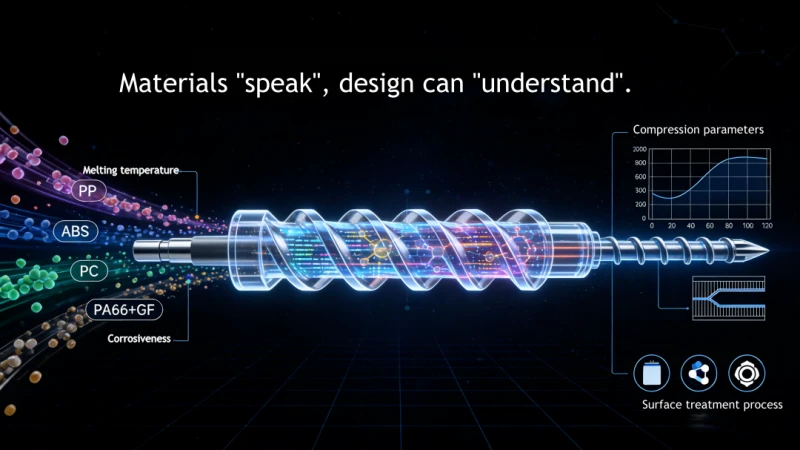
I. Raw Material Melt Property Database: The "Roadmap" for Screw Design
Analysis of Key Melt Parameters
Melt Temperature Range: Significant variations exist across materials (e.g., PP: 160–220°C, PC: 280–320°C), directly influencing heater zone configuration.
Melt Viscosity: High-viscosity materials (e.g., PVC) require greater shear force, while low-viscosity materials (e.g., PA) are prone to backflow.
Thermal Stability: Some materials (e.g., PVC) are temperature-sensitive and decompose easily when overheated.
Corrosive Components: Materials containing halogens or acidic additives demand specialized alloys.
Filler Characteristics: Glass fiber, mineral fillers, etc., exhibit entirely different wear patterns on screws.
II. Core Screw Parameters: Tailoring the Design
1. Selection of Length-to-Diameter Ratio (L/D)
|
Material Type |
Recommended L/D |
Design Rationale |
|---|---|---|
|
Commodity Plastics (PP, PE) |
20:1–25:1 |
Ensures adequate plasticization while controlling machine length. |
|
Engineering Plastics (PA, PBT) |
21:1–24:1 |
Requires longer plasticization time and more uniform temperature distribution. |
|
Thermally Sensitive Plastics (PVC, POM) |
20:1–22:1 |
Minimizes residence time to prevent thermal degradation. |
|
Highly Filled Materials (Glass Fiber >30%) |
22:1–25:1 |
Balances plasticization requirements with wear risk mitigation. |
2. Scientific Basis for Compression Ratio Design
Calculation Formula: Compression Ratio = (Channel Volume in Feed Section) / (Channel Volume in Metering Section)
Design Principles:
Low Compression Ratio (1.8–2.2): Suitable for high-viscosity, thermally sensitive materials.
Medium Compression Ratio (2.2–2.5): General-purpose range, ideal for most engineering plastics.
High Compression Ratio (2.5–3.5): Suitable for low-viscosity materials requiring high-shear melting.
III. Case Studies: From Problem Identification to Solution Implementation
Case 1: Melt Inhomogeneity Causing Dimensional Instability
Customer Situation: An electronics components manufacturer producing precision connectors using ABS material.
Problem: Product dimensions fluctuated by ±0.15 mm, exceeding tolerance limits.
Root Cause Analysis: The existing screw was a general-purpose design with an excessively high compression ratio (3.0:1), causing excessive shear heat and uneven melt temperature.
Solution:
Redesigned the screw with a reduced compression ratio of 2.4:1.
Added mixing elements to improve melt homogeneity.
Applied hard chrome plating to reduce frictional variations.
Result: Product dimensional stability improved to ±0.05 mm, and defect rate dropped from 8% to 1.2%.
Case 2: Rapid Screw Wear Due to Highly Filled Compounds
Customer Situation: An automotive parts manufacturer producing interior trim parts from 50% mineral-filled PP.
Problem: Screw wear reached 0.8–1.0 mm every four months, necessitating frequent replacements.
Root Cause Analysis: High hardness of mineral fillers combined with insufficient screw surface hardness (HV750).
Solution:
Adopted dual-alloy spray welding process, increasing surface hardness to HRC58.
Optimized channel geometry to minimize filler accumulation.
Added wear strips to protect critical wear zones.
Result: Screw service life extended to 16 months, reducing annual maintenance costs by 65%.
Case 3: Corrosion of Screw by Halogen-Free Flame Retardants
Customer Situation: An appliance manufacturer producing housings from halogen-free flame-retardant ABS.
Problem: Corrosion pits appeared on the screw surface within three months, leading to black specks in products.
Root Cause Analysis: Acidic byproducts from flame retardant decomposition corroded the standard nitrided layer.
Solution:
Switched to corrosion-resistant dual-alloy material (nickel-based alloy).
Optimized temperature control profiles to minimize retardant decomposition.
Implemented regular cleaning and maintenance to prevent acid buildup.
Result: Corrosion issues were virtually eliminated; the screw remained in excellent condition after 18 months of service.
IV. Engineer's Selection Guide: Obtaining a "Customized" Screw
1. Information Checklist
Provide your screw supplier with the following comprehensive details:
Complete Material List: Accurate grade of base resin, brands and proportions of all additives (flame retardants, impact modifiers, color masterbatch, regrind, etc.).
Current Screw "Symptoms": Clear photographs of worn or corroded areas; record process parameters (temperature, pressure, screw speed) during anomalies.
Primary Objectives: Are you aiming to increase throughput, improve mixing quality, extend service life, or resolve specific product defects?
2. Selection Decision Matrix
|
Material Characteristic |
Design Focus |
Material Recommendation |
Expected Life Improvement |
|---|---|---|---|
|
High Glass Fiber (>20%) |
Wear-resistant design, smooth conveying |
Wear-resistant dual-alloy |
150%–200% |
|
Halogen-Free FR Compounds |
Corrosion resistance, precise temp. control |
Corrosion-resistant dual-alloy |
200%–300% |
|
Transparent Materials (PC, PMMA) |
Low shear, dead-spot free design |
High-polish chrome plating |
Prevents black specks, improves quality |
|
Thermally Sensitive Materials (PVC, POM) |
Low compression ratio, rapid conveying |
High-polish chrome plating |
Prevents degradation, stabilizes production |
|
High Viscosity Materials (UPVC, TPU) |
High torque design, enhanced mixing |
Reinforced nitriding or dual-alloy |
120%–150% |
Summary
Screw design is not a simple "copy-paste" exercise, but a precision engineering task based on raw material characteristics. Through scientific database support, precise parameter design, and proactive selection strategies, manufacturers can achieve:
Increased Production Efficiency: Optimized melting efficiency reduces cycle times.
Extended Equipment Life: Matching materials and designs lower wear rates.
Enhanced Quality Consistency: Uniform plasticization minimizes product defects.
Reduced Total Cost: Lower expenses related to downtime, maintenance, and scrap.


